← Back to workKHAS-ERDENE TSOGTSAIKHANContact
06AI Socratic PDF learning system

NeuronBook

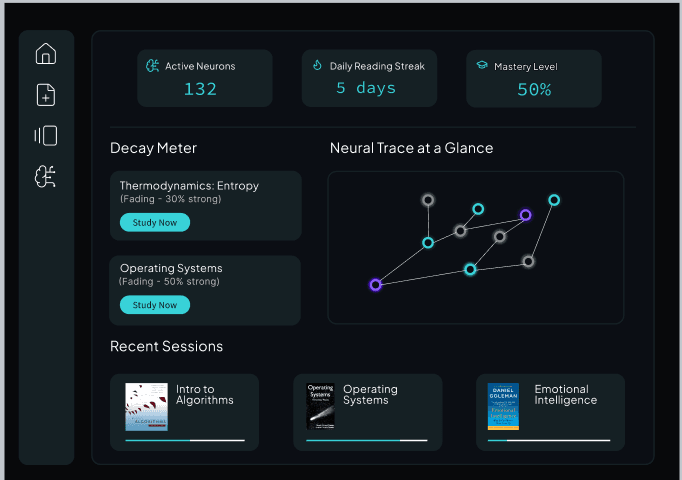
Built an AI-powered PDF learning workspace that turns static documents into Socratic questions, concept memory, difficulty-aware review, and a visual knowledge graph called Neural Trace.

  • Next.js
  • TypeScript
  • LangChain
  • Flask
  • Sanity
  • Foxit Web SDK
  • react-force-graph
NeuronBook dashboard showing active neurons, reading streak, decay meter, and concept graph
Proof artifactBuilder proof · DeveloperWeek 2026 hackathon

Hackathon builder

01 / Problem

What needed to change

Most PDF AI tools summarize documents, which can make studying more passive. NeuronBook asked a harder product question: how can AI help students understand what they read, remember weak concepts, and actively retrieve knowledge?

02 / What I built

The engineering response

A full-stack learning app with browser PDF rendering, page-level context extraction, LangChain-powered Socratic question generation, answer and difficulty tracking, concept extraction, Sanity-backed memory, Neural Trace graph visualization, and You.com enrichment for deeper explanations.

03 / Impact

The signal

Created a functioning DeveloperWeek 2026 Hackathon prototype that combined Foxit Web SDK, Flask, LangChain, Sanity, react-force-graph, and external research retrieval into an adaptive PDF learning loop.

04 / What I learned

The durable insight

AI education products should not only make information easier to consume; they should make learning active by asking questions, tracking weaknesses, and guiding review over time.
Engineering depth

How I engineered it

The constraints, reliability decisions, and system boundaries behind the visible product.

  1. 01

    Designed around active learning instead of summarization: the system needed to ask questions, track weak concepts, and visualize knowledge decay.

  2. 02

    Connected page-level PDF context to LangChain question generation, Sanity-backed concept memory, and a Neural Trace graph so learning state could persist across sessions.

  3. 03

    Used external enrichment for explanations while keeping the core loop tied to the uploaded document, preventing the product from becoming a generic chatbot.

  4. 04

    Modeled concepts, attempts, difficulty, and decay as persistent learning state, allowing retrieval practice and the Neural Trace visualization to evolve across sessions rather than resetting with every prompt.

System architecture
01PDF rendering
02Page context
03Socratic questions
04Concept memory
05Neural Trace graph